The diagonal yellow lines that cut the corners of the image simulate the fasteners that held picture postcards in place in collector’s albums at the time. This visual cue reminds us that this postcard was published at the height of a boom that saw hundreds of thousands of copies of some cards published under government auspices.
Here is a Russo-Japanese War card that employed the same design element, published on October 15th, 1905, with a print-run of 140,000 cards [6]:
[rj0031] Our Infantry Fighting on the River Hun; Our Look-out Erected on a Snow-clad Tree
The postcard album below was assembled from 1904 to 1908 by the Tsubokura family of Tokyo. One of the Tsubokura boys was dispatched to Liaoning and worked in logistics; the album preserves correspondence between the front and Tokyo. These albums were common at the time (photograph by Eric Luhrs).
The top card in the image below (“Taiwan Temple”), is from the 10th anniversary set of the Taiwan Government General (its first officially issued set of postcards). Its presence in the Tsubokura album links the Taiwan cards to the Russo-Japanese War postcard boom, and illustrates the physical attachment mechanism that was easily recognizable to consumers at the time:
Official commemorative Russo-Japanese War cards were issued in print runs ranging from 30,000 to one million; the usual number was around 140,000 cards. Based on these numbers, it would not be reasonable to estimate that at least 50,000, if not more, Taiwan Government General 13th Anniversary cards (with the group portrait from 1874) were produced in 1908.
This postcard image, with caption intact, was reprinted in the January 1916 monthly issue of a Tainan based photography club’s journal. It was one of a 12-photograph series about the Expedition. Aside from reproducing the caption from the 1908 postcard, this reproduction adds no new knowledge about the contents or origins of the photograph. Its radical cropping, lack of explanatory text, and visual marginalization suggest that the editors did not think of the group portrait as an image central to the iconography of the Taiwan Expedition.
[ts0460] The Formosan Punitive invasion in the 7th of Meiji, No.
After its appearance in the album above in 1916, this photograph seems to have kept a very low profile. Yamamoto Yoshimi discovered a 6 postcard set published by Saigo’s family on the twentieth anniversary of Saigo Tsugumichi’s death (1922).
Envelope for six-postcard set published on the 20th anniversary of Saigo Tsugumichi’s death. From private collection of Professor Yamamoto Yoshimi.
Five of the postcards are not connected to 1874:
Five of the six cards in Saigo Tsugumichi 20-year Death Anniversary Set, supplied by Professor Yamamoto Yoshimi.
However, one postcard indeed includes the group portrait, along with a picture of a silver bracelet that Saigo reportedly received from one of the headmen (and did not remove from his wrist for the rest of his life), the Imperial Order to “subjugate the barbarians,” and a note describing the bracelet (Yamamoto 2007, 188):
Saigo Tsugumichi 20-year Death Anniversary Set, supplied by Professor Yamamoto Yoshimi.
There is a copy of this card in the National Central Library’s postcard database (故侯爵與臺灣土人 (National Central Library, Taipei #002414324), and all six postcards are held in microform copy at the Salt Lake City Family History Center in Utah, under the title 故元帥候爵西郷従道二十周年祭記念絵葉書).
The photo was included in an imperial photo collection date the same year, 1922, called “Meiji-Taisho Trans-reign Commemorative Photograph Album.” 『明治大正連続記念写真帖 : 皇室軍事天変人事』. 東京:帝国記念協会.
In the mid-1930s, there was a Saigō boomlet that coincided with the rise of militarism and ultranationalism in the home islands and colonies. Saigō Totoku to Kabayama Sōtoku 西郷都督と樺山總督 was published in 1936. The editors thanked various supporters for raising money for an enormous 5000 yen subvention budget–this publication was indeed a labor-of-love. It is difficult to find an original copy today, suggesting that it had a small print run. This book was published to restore Saigo to a place of prominence in Taiwan’s history, it would seem. Unsurprisingly, then, Mizuno Jun’s name does not appear in the caption. Only Saigo is mentioned by name. In this 1936 version, the “savage settlement chiefs have been summoned-drafted 招集 to be separated out prior to the victory procession in order to be photographed with Commander Saigo.”
According to Professor Fix’s most recent analysis of the portrait, one the headmen sitting next to Saigo was quite possibly “Isa” (or “Esuck”) from Sabaree. Based his collation of a number of contemporary documents and his consultation of the 1936 account mentioned above, Fix also allows for the possibility that “Tokebunkya (土結文脚) from Churaso (豬勞束), Kareitai (加禮帶) from Monsui (蚊蟀), and Abiko (or Amiko 阿眉子) from Monsuiho (蚊蟀埔)” were present in the photograph. Yamamoto also provides this list, based on the same document, in her article. In addition, based on her reading of Kabayama Sukenori’s diary, Yamamoto also puts Isa/Esuck at the site of the photograph. As we have seen, Davidson also named Isa as a sitter for this photo. We can conclude from what is missing in these captions that Japanese image-makers and consumers were not much interested in Langqiao residents, or Paiwans, as individuals with names and biographies. Instead, they were content with general terms like “headman” “savage village” and “savage.” While there is much textual evidence to suggest that Langqiao political leaders considered themselves allies of the Japanese, and that some of them possessed formidable political, linguistic, and diplomatic skills, none of these considerations made it into the visual record I have been tracking in this post.
In the post-colonial period, as we have seen from the genealogy of drawings based on the group portrait, this image continues to circulate, and the captions and contexts continue to shift. Lin Chengrong’s 林呈蓉 The Truth about the Mudan Incident 牡丹社事件的真相 has perhaps followed Davidson in suggesting that Tokitok might present in the photograph. Incidentally, this claim is also reproduced on the Chinese Wikipedia page for Tokitok, which suggests that Davidson’s captioning has been taken at face value by a number of parties.
Lin Chengrong 林呈蓉, Mudan she shijian de zhenxiang 牡丹社事件的真相 (Xin Taipei: Boyang wenhua, 2006), p. 107.
The next reproduction is from a large collection of images organized around the theme of Indigenous resistance to Japanese imperialism, of which the 1874 Expedition forms the first chapter (in this narrative). The author of this book, Gen Zhiyou, has edited several other pictorial studies of Taiwanese resistance to Japanese rule as well as of the Atayal people. Novel to Gen’s usage of this image is his claim that the man seated in the front row all the way to the left is Pan Wenjie (潘文杰,Jagarushi Guri Bunkiet). I have not seen this claim in any study, and suspect that Saigo himself, as well as his family, would have trumpeted Pan’s presence if in fact Pan Wenjie had attended this get-together.
From: Gen Zhiyou 根誌優, 臺灣原住民族抗日史圖輯 : 1874-1933 = Collection of historical photographs of Taiwan’s indigenous people’s resistance against Japanese occupation. 臺北市 : 臺灣原住民, 2010.09.
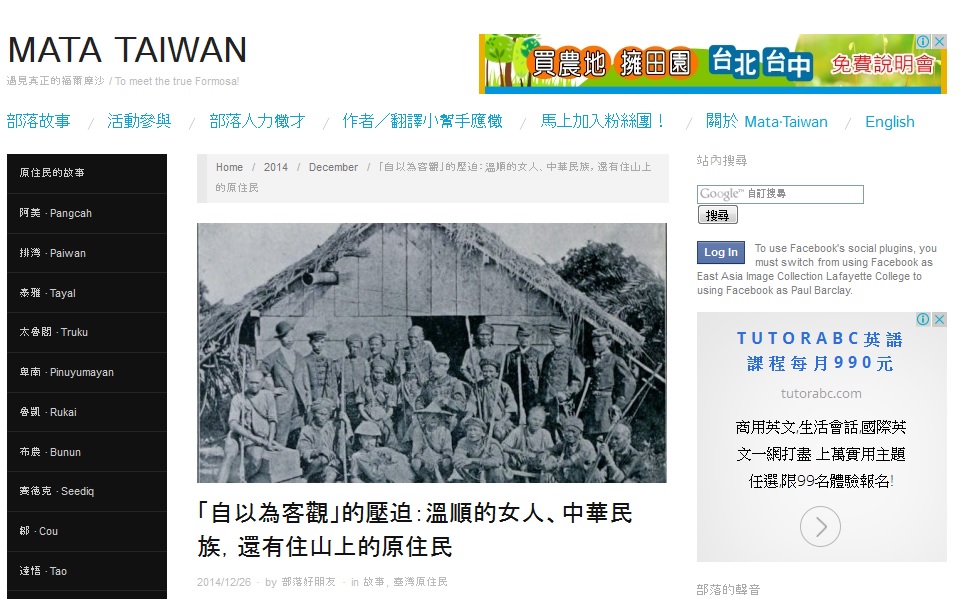
In addition to the above recent books, the group portrait decorates websites, Wiki entries, and coffee-table books that will continue to find many viewers. On this website, it illustrates an opinion piece about the Han Chinese oppression of Indigenous Peoples, both as the lead image and as an embedded issue. Perhaps it is a tribute to this photograph’s revival that it has nothing at all to do with the content of the article!
However widespread this photo has become, it probably was not the dominant image of the Japanese Expedition to Hengchun during the period of Japanese colonial rule. It seems more likely that grave markers and monuments, or even scenic views of Stone Gate, were more pervasive.


 Dovoha